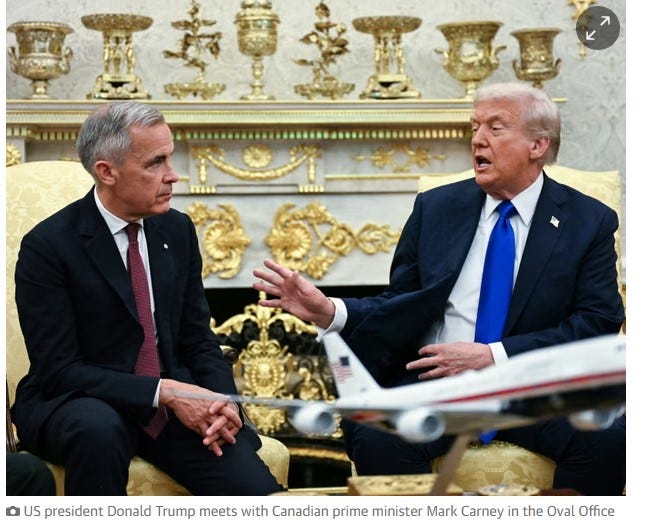
Donald Trump raises tariffs on Canada as he attends the Association of Southeast Asian Nations (ASEAN) summit with Mark Carney.
🇺🇸 What Happened
On October 25, 2025, President Donald Trump announced via his social-media account (Truth Social) that the United States will raise tariffs on Canadian imports by 10 per cent, citing a television advertisement produced by the government of Ontario as a “hostile act” and a misrepresentation of U.S. trade policy. The Guardian+3The Washington Post+3Reuters+3
The ad, paid for by Ontario’s provincial government and aired in the U.S., features archival audio from former President Ronald Reagan advocating that tariffs damage American jobs and trade; Trump labelled it misleading and aimed at influencing U.S. trade disputes. Sky News+1
At the same time, both Trump and Canadian Prime Minister Mark Carney are attending the ASEAN summit in Malaysia, although Trump explicitly told reporters he has no intention of meeting Carney during the summit. The Guardian+1
🔍 Why It Matters
- This move further strains relations between the U.S. and its close ally Canada — one of the largest trading partners of the United States. Reuters+1
- The tariff increase seems triggered not purely by trade imbalance but by a political dispute over a public advertisement, indicating how trade policy may be influenced by messaging and public perceptions.
- It comes during a major international trip for President Trump — his Asia tour including Malaysia, Japan, South Korea — and signals that he is willing to escalate trade measures even when engaging with broader multilateral forums like ASEAN. The Guardian+1
- For Canada, represented by Carney, this heightens the need to diversify trade and reduce dependency on the U.S. market. Carney indicated in Malaysia that Canada “stands ready” to resume trade talks, despite the escalation. amp.scmp.com
📋 The Key Elements
- Trigger: Ontario-government-funded ad aired in the U.S., using text from Reagan’s speech about tariffs. Reuters+1
- Reaction: Trump described the ad as “serious misrepresentation … a hostile act,” and announced the 10% tariff increase. Reuters+2Sky News+2
- Scope: It is not fully clear exactly which Canadian goods will be affected and when the 10% increase takes effect; most large-scale trade between U.S. & Canada remains covered under existing trade agreements. Reuters+1
- Timing & Venue: The announcement comes while Trump is traveling to Asia (Malaysia first stop), during the ASEAN summit where Carney is also attending. Yet Trump declined to meet with Carney at this time. The Guardian
- Canada’s Position: Carney emphasized Canada remains open to negotiations, and that trade talks are the “best way forward.” He also stressed the federal government will handle negotiations. amp.scmp.com
🧮 Implications & Risks
- Escalation of tariffs may provoke counter-measures from Canada, which could ripple through industries heavily dependent on bilateral trade (auto, lumber, agriculture).
- The U.S.’s trade-policy credibility could be impacted: allies may view the tariff shift as unpredictable and politically driven.
- Canadian firms may accelerate efforts to diversify away from the U.S. market, reducing American leverage over time.
- At the ASEAN summit, the move may complicate U.S. efforts to present itself as a stable trading partner in Asia-Pacific, given the signal that even close allies are subject to abrupt tariff hikes.
- For domestic U.S. politics, the move underlines Trump’s “America First” trade posture and his willingness to challenge longstanding bilateral relationships.


Comments
Post a Comment