Trump administration asks Supreme Court to allow deployment of National Guard in Chicago area”
“Trump administration asks Supreme Court to allow deployment of National Guard in Chicago area”
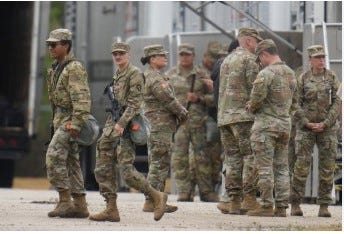
WASHINGTON — Emergency Appeal to the Supreme Court
On October 17, 2025, the Trump administration filed an emergency request with the U.S. Supreme Court seeking to overturn a federal judge’s temporary order that has blocked deployment of National Guard troops in Illinois — particularly in the Chicago area. AP News+3AP News+3SCOTUSblog+3
The administration wants the court to stay (pause) the lower court’s injunction “in its entirety,” arguing the ruling interferes with the President’s authority as Commander in Chief and endangers federal personnel and property. ABC News+2SCOTUSblog+2
Background: Court Battles & Deployment Block
- Earlier, U.S. District Judge April Perry issued a temporary restraining order on October 9, preventing the federalization and deployment of National Guard forces in Illinois until at least October 23. She found that the administration had not sufficiently demonstrated that there was a “danger of rebellion” justifying the use of federal troops domestically. AP News+4SCOTUSblog+4AP News+4
- The administration appealed to the 7th Circuit Court of Appeals, which largely upheld Perry’s block on deploying troops, though it allowed Guard members already federalized to remain in position (i.e. they can remain under federal control) while litigation continues. AP News+4Reuters+4AP News+4
- In its appeal, the 7th Circuit agreed that the lower court’s decision blocking deployment should stand, citing lack of sufficient evidence of rebellion or that federal law enforcement was incapacitated. The Washington Post+3SCOTUSblog+3Politico+3
Because of that, the Trump administration says the Supreme Court must intervene now, before the lower court order blocks the deployment permanently. SCOTUSblog+2ABC News+2
The Administration’s Arguments
In its filing:
- Solicitor General John Sauer argues the lower court’s injunction “countermands the exercise of the President’s Commander-in-Chief authority,” and impedes the protection of federal agents and facilities in Chicago. CBS News+3SCOTUSblog+3ABC News+3
- He contends that federal agents have encountered violent resistance — including being attacked, rammed, threatened, and hurt — while enforcing immigration laws in Chicago. He claims this justifies deploying the Guard under Title 10 authority. SCOTUSblog+1
- The administration also asks for an immediate administrative stay, so that troops can be deployed while the Supreme Court considers the dispute. SCOTUSblog+1
- According to the request, the deployment would be “protective” — not for general policing of civilians, but to safeguard federal property, personnel, and enforcement operations. CBS News+2SCOTUSblog+2
State & Local Opposition
Illinois and the City of Chicago have pushed back, filing suit against the federal government. Their arguments include:
- The state claims that the federal government’s attempt to deploy troops infringes on state sovereignty and the constitutional balance of power. CBS News+2AP News+2
- Local officials argue that the administration inflated or misrepresented conditions (e.g. protests, resistance) in order to manufacture a legal rationale for military deployment. CBS News+3Democracy Docket+3SCOTUSblog+3
- Governor J.B. Pritzker has denounced the move as “un-American” and unconstitutional, insisting the state will continue defending its rights. CBS News+1
- Chicago Mayor Brandon Johnson has also objected, warning that militarization could inflame tensions and harm civil trust. The Guardian+1
What’s at Stake & Next Steps
- The Supreme Court has asked Illinois and Chicago to respond by 5 p.m. Eastern on Monday, October 20. SCOTUSblog+1
- If the Court grants the stay, it could allow troops to be deployed immediately while further legal processes play out. If denied, the lower court’s block would stand — at least temporarily. SCOTUSblog+2AP News+2
The case raises critical constitutional questions:
• The limits on presidential authority to deploy military forces domestically, especially absent a clear rebellion or invasion.
• The role of federal courts in reviewing the President’s judgments about national security and enforcement.
• The balance between federal power and state sovereignty, especially under the Tenth Amendment and laws like the Posse Comitatus Act (which restricts military involvement in civilian law enforcement). Democracy Docket+4SCOTUSblog+4AP News+4
This is a high-stakes case that may define how far the executive branch can reach into domestic law enforcement and federal–state relations going forward.


Comments
Post a Comment